Professor Tseng Shun-Fen’s Laboratory

.jpg)
Interleukin-17A Links Obesity-Induced Inflammation to Behavioral Disorders and Autonomic Imbalance
This study aimed to determine whether interleukin-17A (IL-17A) contributes to obesity-associated emotional behavioral abnormalities and autonomic dysfunction, based on our findings that high-fat diet (HFD) feeding caused an increase in plasma IL-17A levels and hypothalamic IL-17A mRNA expression. Furthermore, exogenous IL-17A administration shows emotional behavioral abnormalities, meningeal immune cell infiltration, and microglial activation in emotion-related brain regions, accompanied by reduced heart rate variability. Yet, neutralization of IL-17A in plasma derived from obese mice attenuated these behavioral and physiological abnormalities. Collectively, these findings indicate that IL-17A serves as a key mediator linking obesity to neuroinflammation, emotional disturbances, and autonomic dysfunction, highlighting its potential as a therapeutic target.
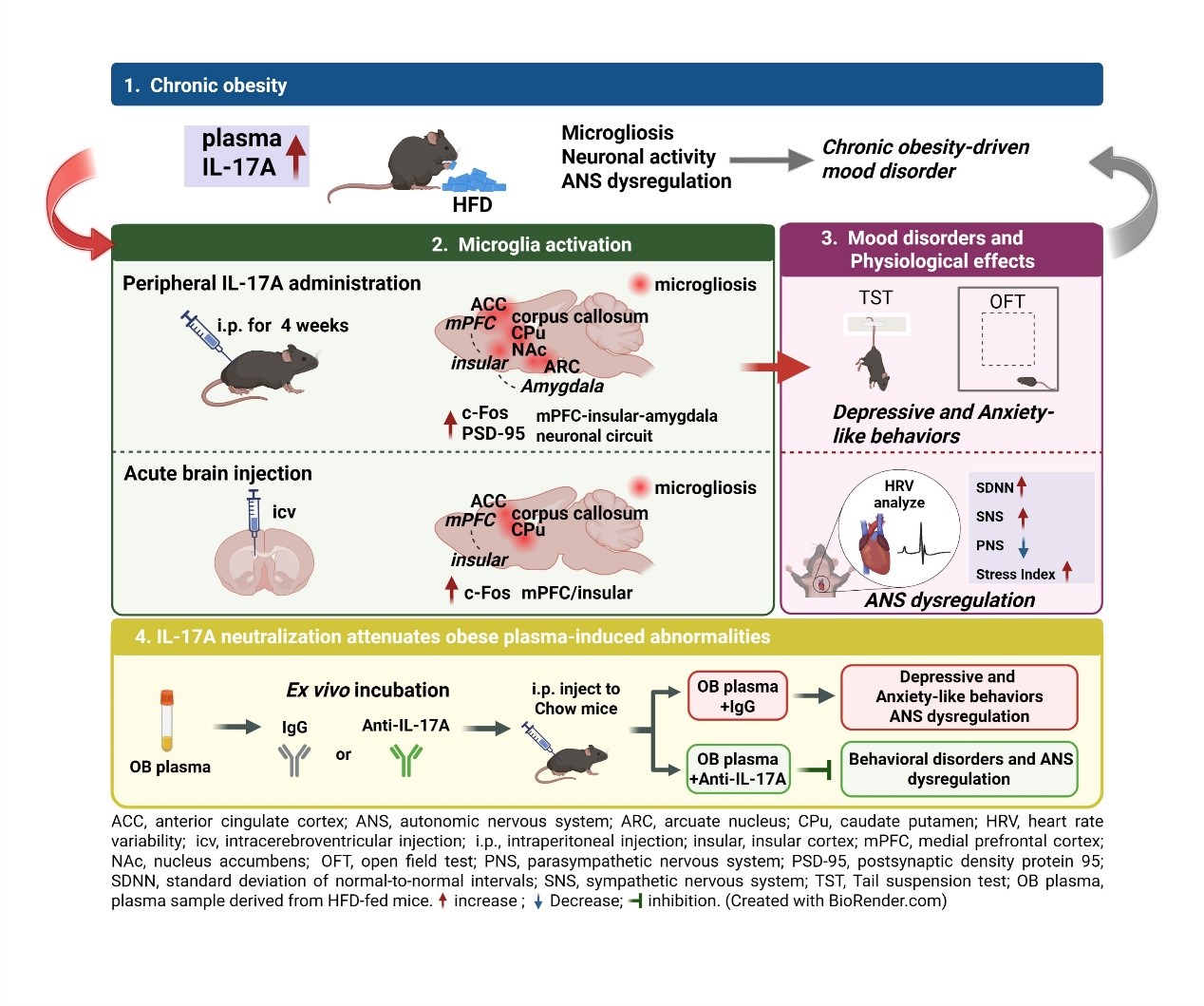
(https://onlinelibrary.wiley.com/doi/full/10.1002/glia.70237?utm_source=sfmc&utm_medium=email&utm_campaign=B2CJNL_MIS_1536100_ATP_PostPublication_Congratulations_EM1)
Jing-Ting Fu, Ya-Hsin Liu, Hui-Ting Huang, Yu-Min Kuo, Pei-Chun Chen, Po-See Chen, Shun-Fen Tzeng*. Interleukin‐17A Links Obesity‐Induced Inflammation to Behavioral Disorders and Autonomic Imbalance. (2026). Glia, 74(12), e70237.