.jpg)
Hao-Jen HuangDistinguished Professor & Chairman
E - Mail
haojen@mail.ncku.edu.tw
Office Phone
+886-6-275-7575 ext. 58126
Laboratory Phone
58104 or 58114#58
Highest Education
Ph.D., Department of Biochemistry, University of Oxford
M.S., Institute of Plant Science, National Taiwan University
B.S., Department of Biology, National Cheng Kung University
M.S., Institute of Plant Science, National Taiwan University
B.S., Department of Biology, National Cheng Kung University

Brief Biography
2016.8 – present Vice Dean, College of Bioscience and Biotechnology, National Cheng Kung University
2015.8 – present Director, Institute of Tropical Plant Sciences, National Cheng Kung University
2012.8 – 2015.8 Chair and Director, Department of Life Sciences, National Cheng Kung University
2009 – present Distinguished Professor, Department of Life Sciences, National Cheng Kung University
2005 – 2009 Professor, Department of Life Sciences, National Cheng Kung University
2002 – 2005 Associate Professor, Department of Life Sciences, National Cheng Kung University
1999 – 2002 Assistant Professor, Department of Biology, National Cheng Kung University
1999 Postdoctoral Research Fellow, Institute of Molecular Biology, Academia Sinica
2015.8 – present Director, Institute of Tropical Plant Sciences, National Cheng Kung University
2012.8 – 2015.8 Chair and Director, Department of Life Sciences, National Cheng Kung University
2009 – present Distinguished Professor, Department of Life Sciences, National Cheng Kung University
2005 – 2009 Professor, Department of Life Sciences, National Cheng Kung University
2002 – 2005 Associate Professor, Department of Life Sciences, National Cheng Kung University
1999 – 2002 Assistant Professor, Department of Biology, National Cheng Kung University
1999 Postdoctoral Research Fellow, Institute of Molecular Biology, Academia Sinica
Research Areas
News Report:
Broccoli Can Grow All Year Round
Professor Hao-Jen Huang of NCKU Develops Molecular Marker Detection for Heat-Tolerant Broccoli Seedlings 2012.2.1
Research Directions:
1. Stress Signal Transduction: Systematic biological analysis of regulatory mechanisms in plants under environmental stress
Plants are sessile organisms. Under environmental stresses such as cold injury, heat stress, drought, heavy metal pollution, and other biotic stresses including insect attacks and pathogen infections, they cannot escape by movement. Like other organisms, plants must first perceive and recognize stress before responding to it. Although many studies have explored possible plant responses and signaling pathways under various stresses, a complete description and detailed molecular mechanisms remain to be clarified. Our laboratory analyzes transcriptomic changes in plants under stress conditions through transcriptome profiling. Our analyses have revealed that many environmental stresses induce oxidative stress, calcium ions, CDPK, MAPK, and other signaling pathways involved in plant stress responses. However, how plants regulate different responses through commonly induced signaling pathways and how stress-specific signaling pathways function under various environmental stimuli remain unclear. Through understanding transcriptomic changes in plants under stress conditions, we hope to contribute to future plant breeding and potential food security issues.
2. Microbial Assistance in Plant Physiology and Growth under Extreme Environmental Stress
In the 21st century, issues such as climate change and human-induced environmental pollution have made the impact of extreme environments on biological populations an important topic in ecology and evolutionary biology. Although many studies have investigated molecular mechanisms of organisms under extreme environments, the mechanisms by which plants adapt to extreme habitats in nature remain largely unknown. Recent studies have found that interactions between plants and rhizosphere microorganisms can help plants adapt to extreme environments, and microbial volatile compounds that assist plants in stress adaptation have become an emerging research topic in recent years.
In my recent studies and projects, wild plant species growing in natural environments are collected for comparative analyses of physiology, transcriptomic profiles, and rhizosphere metatranscriptomics between plants tolerant to extreme environments and normal plants. These analyses aim to understand genomic evolution and molecular mechanisms underlying tolerance to extreme environments. Through next-generation sequencing analyses of plant root transcriptomes and metatranscriptomes, we seek to better understand the biological mechanisms of plant interactions with extreme environments. The contribution of this research is to provide a more comprehensive understanding of plant responses and adaptation mechanisms under extreme environments, laying the foundation for future analyses of molecular mechanisms and evolutionary adaptation in wild species. Another aspect of the research utilizes genomic tools to further investigate how microbial volatile compounds influence plant physiology and signaling pathways under stress conditions.
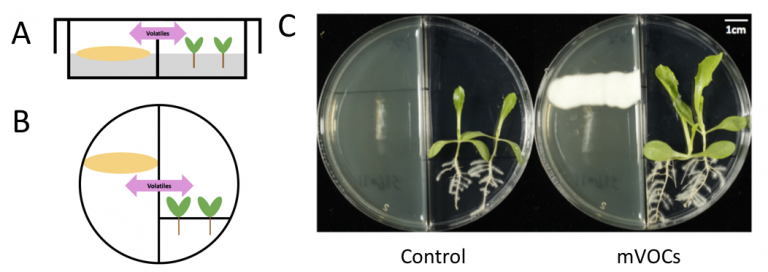
Figure 1. Microbial volatile compounds isolated from soil promote plant growth.
A. Side view of the apparatus used for treating plants with microbial volatile compounds.
B. Top view of the apparatus used for treating plants with microbial volatile compounds.
C. Co-cultivation of fungi and Quanzhou cabbage in a divided Petri dish.
Broccoli Can Grow All Year Round
Professor Hao-Jen Huang of NCKU Develops Molecular Marker Detection for Heat-Tolerant Broccoli Seedlings 2012.2.1
Research Directions:
1. Stress Signal Transduction: Systematic biological analysis of regulatory mechanisms in plants under environmental stress
Plants are sessile organisms. Under environmental stresses such as cold injury, heat stress, drought, heavy metal pollution, and other biotic stresses including insect attacks and pathogen infections, they cannot escape by movement. Like other organisms, plants must first perceive and recognize stress before responding to it. Although many studies have explored possible plant responses and signaling pathways under various stresses, a complete description and detailed molecular mechanisms remain to be clarified. Our laboratory analyzes transcriptomic changes in plants under stress conditions through transcriptome profiling. Our analyses have revealed that many environmental stresses induce oxidative stress, calcium ions, CDPK, MAPK, and other signaling pathways involved in plant stress responses. However, how plants regulate different responses through commonly induced signaling pathways and how stress-specific signaling pathways function under various environmental stimuli remain unclear. Through understanding transcriptomic changes in plants under stress conditions, we hope to contribute to future plant breeding and potential food security issues.
2. Microbial Assistance in Plant Physiology and Growth under Extreme Environmental Stress
In the 21st century, issues such as climate change and human-induced environmental pollution have made the impact of extreme environments on biological populations an important topic in ecology and evolutionary biology. Although many studies have investigated molecular mechanisms of organisms under extreme environments, the mechanisms by which plants adapt to extreme habitats in nature remain largely unknown. Recent studies have found that interactions between plants and rhizosphere microorganisms can help plants adapt to extreme environments, and microbial volatile compounds that assist plants in stress adaptation have become an emerging research topic in recent years.
In my recent studies and projects, wild plant species growing in natural environments are collected for comparative analyses of physiology, transcriptomic profiles, and rhizosphere metatranscriptomics between plants tolerant to extreme environments and normal plants. These analyses aim to understand genomic evolution and molecular mechanisms underlying tolerance to extreme environments. Through next-generation sequencing analyses of plant root transcriptomes and metatranscriptomes, we seek to better understand the biological mechanisms of plant interactions with extreme environments. The contribution of this research is to provide a more comprehensive understanding of plant responses and adaptation mechanisms under extreme environments, laying the foundation for future analyses of molecular mechanisms and evolutionary adaptation in wild species. Another aspect of the research utilizes genomic tools to further investigate how microbial volatile compounds influence plant physiology and signaling pathways under stress conditions.
Figure 1. Microbial volatile compounds isolated from soil promote plant growth.
A. Side view of the apparatus used for treating plants with microbial volatile compounds.
B. Top view of the apparatus used for treating plants with microbial volatile compounds.
C. Co-cultivation of fungi and Quanzhou cabbage in a divided Petri dish.
Awards
2013 Appointed President of the Society of Biology of China and received the Outstanding Research Award in Biological Sciences from the Society
2009 – present Distinguished Professor, National Cheng Kung University
2009 – present Distinguished Professor, National Cheng Kung University