.jpg)
I-Ching ChenProfessor

Brief Biography
2011-2012 Postdoctoral Fellow, Biodiversity Research Center, Academia Sinica
Research Areas
Current Research Topics:
- Biological responses under climate change, focusing on the impacts of geographic distribution shifts on species interactions and ecosystems
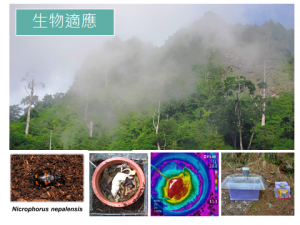
- Evolutionary adaptation mechanisms of organisms in response to climate variability, including distribution range, physiological, and ecological traits
- Assessment of biodiversity–climate change vulnerability
- Climate reconstruction and ecosystem services of tropical cloud forests
Research Outputs
2017
Climate change leads to shifts in species distributions, but what are the consequences of these changes? Based on studies over the past two to three decades, we found that distribution shifts not only affect species themselves, but also impact ecosystems, human food security and health, and even create feedback effects on climate.
Human life relies on ecosystem services such as diverse food resources, stable water supply, and recreational resources. Species distribution shifts have already affected these services. For example, changes in crop production areas and fisheries continue to impact food security and may trigger conflicts over fishing rights. Changes in coral reefs and mangroves not only alter entire biological communities but also affect ecosystem functions, thereby reducing tourism value and economic output. Expansion of disease vectors such as mosquitoes challenges public health systems. Plant invasions into polar regions accelerate regional ice melting and warming, creating positive feedback to global warming, and so on.
“Species distribution shifts” is an emerging interdisciplinary topic closely related to several UN Sustainable Development Goals, including “Zero Hunger,” “Human Health,” “Clean Water,” and “Responsible Consumption and Production.” Even if greenhouse gas emissions were stopped now, humanity would still face ongoing impacts from climate and species distribution changes. Recognizing these impacts is essential for global ecological change and sustainable development.
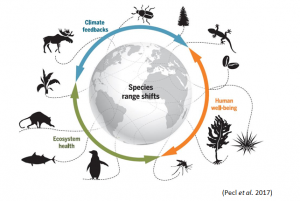
Animated summary: “Species on the move: impacts on ecosystems and human well-being”
The Guardian: “Climate change: global reshuffle of wildlife will have huge impacts on humanity”
NCKU News Center: “NCKU Professor Chen Yi-Ching’s collaborative Science paper published”
China Times: “NCKU researcher Chen Yi-Ching publishes in Science”
Tech Life News: “Climate and biodiversity change study by NCKU team published in Science”
2016
Diurnal and seasonal temperature variation occurs at different temporal scales, and organisms must adapt accordingly. The climate variability hypothesis suggests that species at higher latitudes, where seasonal variation is stronger, have broader thermal tolerance and thus wider distributions. We found that daily temperature variation and annual temperature variation have opposite effects on species range size. This supports the optimal phenotype model proposed by Gilchrist (1995): when temperature variation is dominated by long-term fluctuations, organisms tend to expand thermal tolerance and distribution range; when short-term variation dominates, organisms narrow their thermal tolerance to achieve higher adaptability and thus have more restricted distributions. This study shows that short-term temperature variability may play a key role in shaping climate adaptation and provides important insights for macro-physiological ecology and climate change biology.
Liberty Times: “Taiwan ecological study published in top international journal”
UDN Video: “Testing ecological hypotheses: diurnal temperature range affects species distribution”
NCKU News Center: “Assistant Professor Chen Yi-Ching publishes twice in Science”
2015
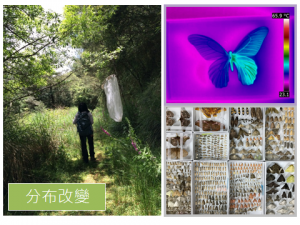
Species distributions are shifting toward higher latitudes and elevations due to climate warming, but lowland tropical regions remain understudied. We found that butterflies in western Taiwan plains may already be shifting northward due to climate warming, and that the direction of movement is related to species traits. Continuous tracking of climatic niches leads to ongoing changes in community composition, but no replacement species exist in island tropical lowlands, ultimately resulting in biotic attrition.
2014
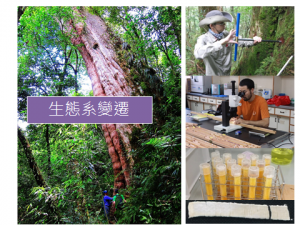
Tropical cloud forests are highly distinctive ecosystems in Taiwan and low-latitude mountain regions, and are extremely vulnerable under climate change. Cloud formation is highly sensitive to climate and human disturbance, and species dependent on cloud conditions require urgent attention. We found that Taiwan’s cloud forest zone may be under severe pressure, as the past 30 years represent the lowest average rainfall and highest frequency of extreme events in the past 500 years.
PanSci: “Are extreme rainfall events recent? Hinoki cypress tells you”
2011
Human-induced climate change has led to rapid global shifts in species distributions. We estimated that species are shifting poleward at a rate of 16.9 km per decade and upward in elevation at 11.0 m per decade. The degree of distribution change increases with warming intensity. These updated estimates are 2–3 times faster than previous assessments, indicating rapid community restructuring and major implications for biodiversity conservation.
CNN: “Warming drives animals to higher ground, latitudes, study finds”
BBC: “Species flee warming faster than previously thought”
Washington Post: “Up and up: Plants and animals migrating as climate changes”
Liberty Times: “Warming drives species migration, faster than expected”
2009
The effects of global climate change on tropical ecosystems remain controversial due to limited historical data. By studying 40 years of elevational distribution of moths in Mount Kinabalu, Borneo, we found that tropical insects may already be shifting upward in elevation due to climate warming. Considering the high biodiversity and narrow thermal tolerance of tropical organisms, climate change raises important concerns for tropical conservation biology.
Science Daily: “Global Impact Of Climate Change On Biodiversity”