.jpg)
Cheng-Han TsaiAssociate Professor

Brief Biography
2022–2024 Postdoctoral Researcher, Department of Applied Mathematics, University of California, Santa Cruz, USA
2021–2022 Postdoctoral Researcher, Department of Ecology and Evolutionary Biology, University of California, Santa Cruz, USA
2021–2024 Postdoctoral Researcher, Southwest Fisheries Science Center, National Oceanic and Atmospheric Administration (NOAA), USA
2011–2014 Research Assistant, Institute of Oceanography, National Taiwan University
2010–2011 Research Assistant, Department of Atmospheric Sciences, National Taiwan University
Research Areas
Research Fields: Community Ecology, Marine Ecological Resource Conservation, Coral Reef Ecosystems, Nonlinear Systems, Decision-Making Processes.
Current Research Topics:
1.Biodiversity Change and Ecosystem Stability:
We investigate how fluctuations in coral cover driven by climate change and human activities affect the structure and stability of coral reef fish communities. Using a long-term, spatially replicated ecological dataset from the Great Barrier Reef, Australia, this study highlights the dynamic balance between deterministic niche-based processes (e.g., species traits) and stochastic processes (including neutral assembly mechanisms). Under high variability conditions, stochastic processes gradually dominate. Although biodiversity indices such as species richness and evenness remain relatively stable, the erosion of niche structure poses potential risks to ecosystem functioning and service provision. These findings challenge traditional biodiversity metrics, which often overlook structural changes driven by environmental variability. By decomposing sources of variation in species relative abundance, we emphasize the need for dynamic approaches that capture temporal and structural changes in biodiversity. The study advocates adaptive conservation strategies, highlighting that preserving species diversity alone is insufficient to maintain ecosystem stability. See Tsai & Connolly 2025, Tsai et al. 2022.
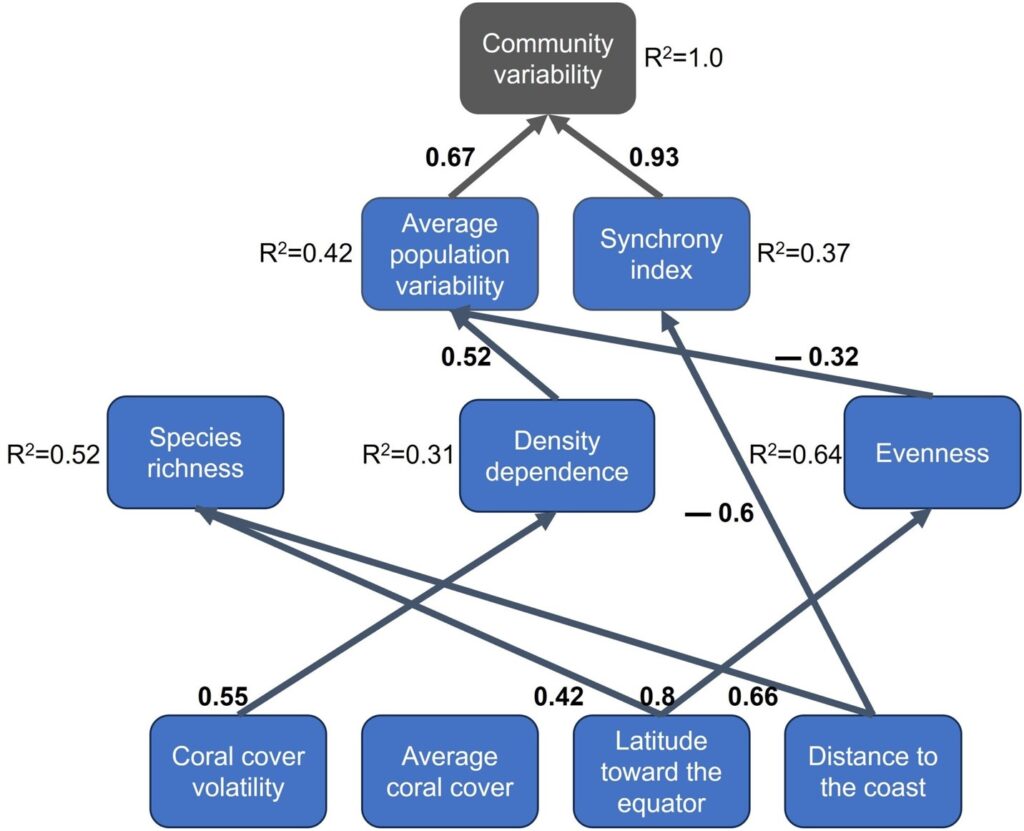
Figure: Tsai and Connolly (2025) examined synchrony and stability in Great Barrier Reef fish communities using 27 years of data from 39 communities, combined with ecosystem-based modeling. The study decomposed temporal variance in total community abundance into “synchrony” and “mean population variability.” Both components contributed to community variability, with synchrony being the dominant factor. The hypothesis that biodiversity enhances stability is supported: communities with higher species richness show lower variability and synchrony. However, this relationship is largely driven by environmental factors. Nearshore reefs, which are more influenced by anthropogenic nutrient input and disturbances, exhibit lower species richness, higher synchrony, and greater community fluctuations. In contrast, offshore reefs show higher richness and greater stability. The study emphasizes that anthropogenic impacts often act on multiple species simultaneously, increasing synchrony and reducing community stability.
2.Nonlinear Time-Series Forecasting and Ecosystem-Based Resource Management:
We focus on theoretical and applied advances in ecological dynamics forecasting and fisheries science, particularly for short-lived marine species. Traditional stock assessment models often fail to capture their nonlinear dynamics, leading to outdated or inaccurate reference points. To address this, we apply Empirical Dynamic Modeling (EDM), a nonlinear, equation-free approach that incorporates unobserved ecological interactions and environmental drivers to estimate management reference points such as Maximum Sustainable Yield (MSY). Using penaeid shrimp dynamics in the Gulf of Mexico as a case study, we demonstrate EDM’s ability to predict nonlinear dynamics and spatial synchrony, improving real-time fisheries management and supporting adaptive policy design. Results suggest that EDM provides a promising framework for transitioning from reactive to proactive management of short-lived species. See Tsai et al. 2024, Tsai et al. 2023.
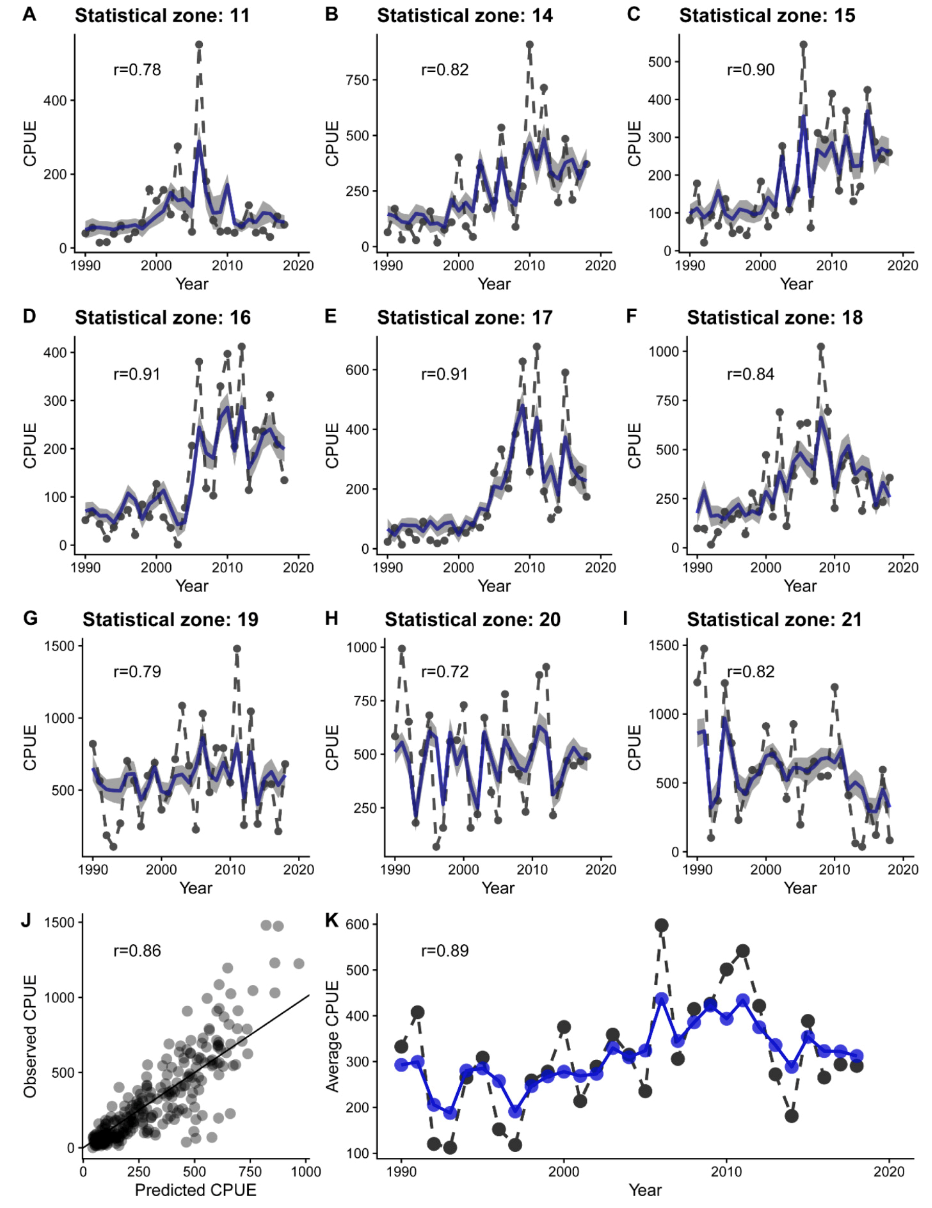
Figure: Tsai et al. (2023) used 30 years of non-fishery survey data from the Gulf of Mexico across multiple states to study short-lived shrimp population dynamics. Due to delayed reporting and high interannual variability in CPUE, traditional stock assessment models performed poorly. The team applied a Gaussian Process Empirical Dynamic Model (GP-EDM), successfully predicting interannual abundance fluctuations of brown and white shrimp across regions with higher accuracy than conventional methods. The model revealed nonlinear, temperature-dependent density feedbacks and uncovered hidden dynamical similarities among geographic regions. GP-EDM also shows potential for integration with real catch data and reinforcement learning as a predictive fisheries control tool (Tsai et al. 2024), and may be further combined with age-structured models to support sustainable management benchmarks.
3.Chaos in Ecology and Evolutionary Biology:
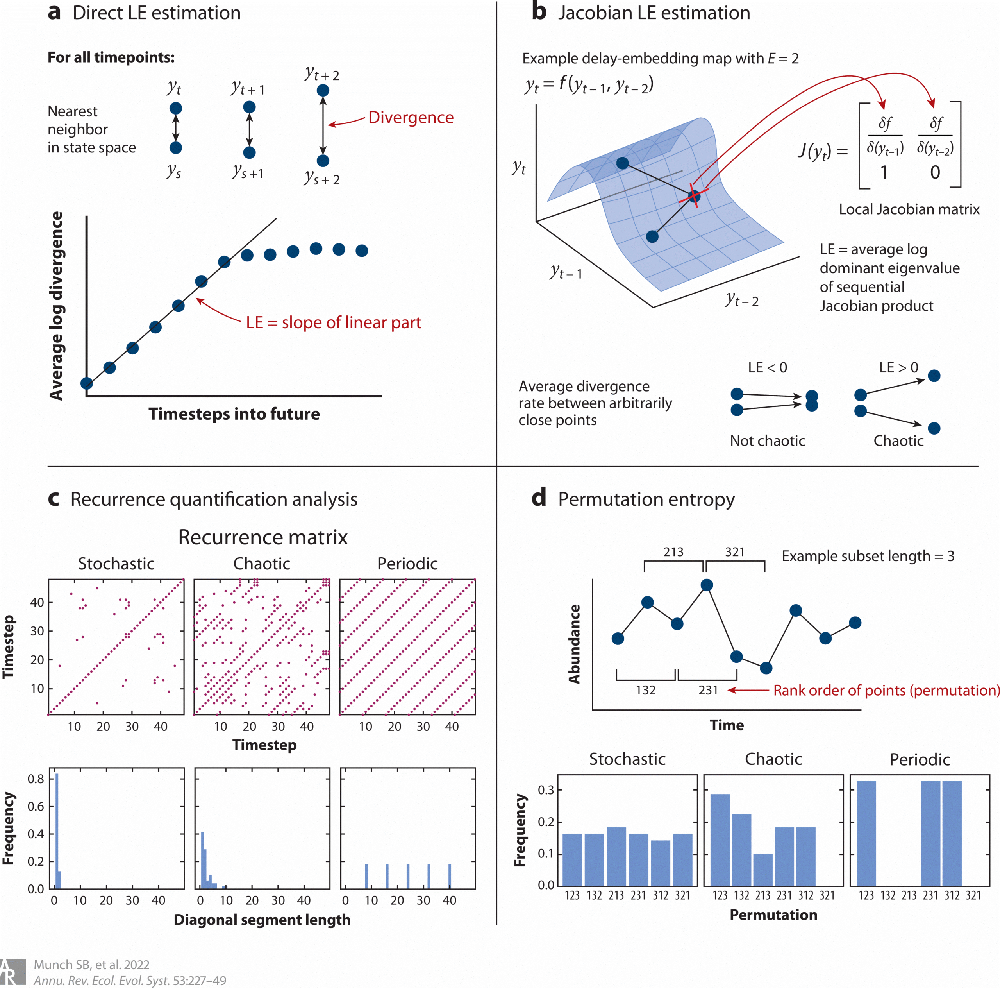
We revisit the long-standing assumption that chaotic dynamics are rare in natural ecological systems. By integrating advances in recurrence quantification, permutation entropy, and Takens’ theorem–based methods, we argue that natural ecological and evolutionary systems often satisfy conditions that give rise to chaotic dynamics. These insights challenge traditional equilibrium-based models and highlight limitations arising from data constraints and overreliance on low-dimensional representations. See Munch et al. 2022.